B1 covers the mechanical side of aircraft maintenance, airframes, engines, and structural systems, while B2 covers avionics, the electrical, instrument, and electronic systems that fly and monitor the aircraft. Choose B1 if you're drawn to hands-on mechanical troubleshooting; choose B2 if you'd rather work with wiring, displays, and flight computers. Most engineers can add the second category later without repeating the shared foundation modules.
Both are Part-66 category B licenses recognized by the Pakistan Civil Aviation Authority (PCAA) and, where an institute teaches the parallel EASA syllabus, by the European Union Aviation Safety Agency (EASA) as well. Picking between them is one of the biggest early decisions in an Aircraft Maintenance Engineering career in Pakistan, since it shapes which modules you study first, what your daily work looks like once you're licensed, and how easily you can move employers later. This guide breaks down the exact differences in scope, modules, training duration, conversion routes, salary, and career paths, then walks through Aviation Training Hub's (ATH) own program structure as a worked example of how the two categories play out in practice.
What Are the B1 and B2 Aircraft Maintenance License Categories?
A B1 license authorizes an engineer to certify maintenance on an aircraft's mechanical systems, while a B2 license authorizes certification of avionics and electrical systems. Both sit under the broader "Category B" umbrella of aircraft maintenance licenses defined in EASA Part-66 and mirrored in PCAA's own licensing structure, and both give the holder the authority to issue a Certificate of Release to Service (CRS) within their scope once type-rated on a specific aircraft.
Per the European Union Aviation Safety Agency's official Part-66 guidance, the two categories exist because modern commercial aircraft combine two genuinely different disciplines, mechanical engineering and electronics, and separating them into distinct licenses lets each engineer build deep expertise rather than a shallow understanding of both. This same category split, and the cross-border recognition it enables, traces back to ICAO's Annex 1 personnel-licensing standard, which most national authorities, including PCAA, build their own rules around.
- B1 (Mechanical): Certifies release to service on airframes, engines, and mechanical/electrical systems, plus simple avionics line-replaceable unit checks that require no troubleshooting.
- B2 (Avionics): Certifies release to service on avionics, electrical, and instrument systems, including the complex troubleshooting and defect rectification that sits outside B1's simple-test scope.

B1 vs B2: The Core Differences at a Glance
The fastest way to compare B1 and B2 is side by side, since the two categories diverge on subcategories, module count, typical training length, and the systems each one authorizes an engineer to sign off on.
| Feature | B1 (Mechanical) | B2 (Avionics) |
|---|---|---|
| Primary focus | Airframe, engines, and mechanical/electrical systems | Avionics, electrical, and instrument systems |
| Subcategories | B1.1, B1.2, B1.3, B1.4 (aircraft-type specific) | Single B2 category, no subcategories |
| Shared foundation modules | 10 (Modules 1-10) | 10 (Modules 1-10, same set) |
| Category-specific modules | 3 additional (Modules 11, 15, 17 for B1.1) | 2 additional (Modules 13, 14) |
| Total exam modules | 13 (B1.1 pathway) | 12 |
| Typical scope of work | Structural repairs, engine removal/installation, hydraulics, landing gear | Wiring, LRU swaps, navigation/communication systems, autopilot, cockpit displays |
| Can certify complex avionics defects? | No, beyond simple tests | Yes, this is the core scope |
| Can certify major structural/engine work? | Yes, this is the core scope | No |
What Does a B1 Licensed Engineer Actually Do?
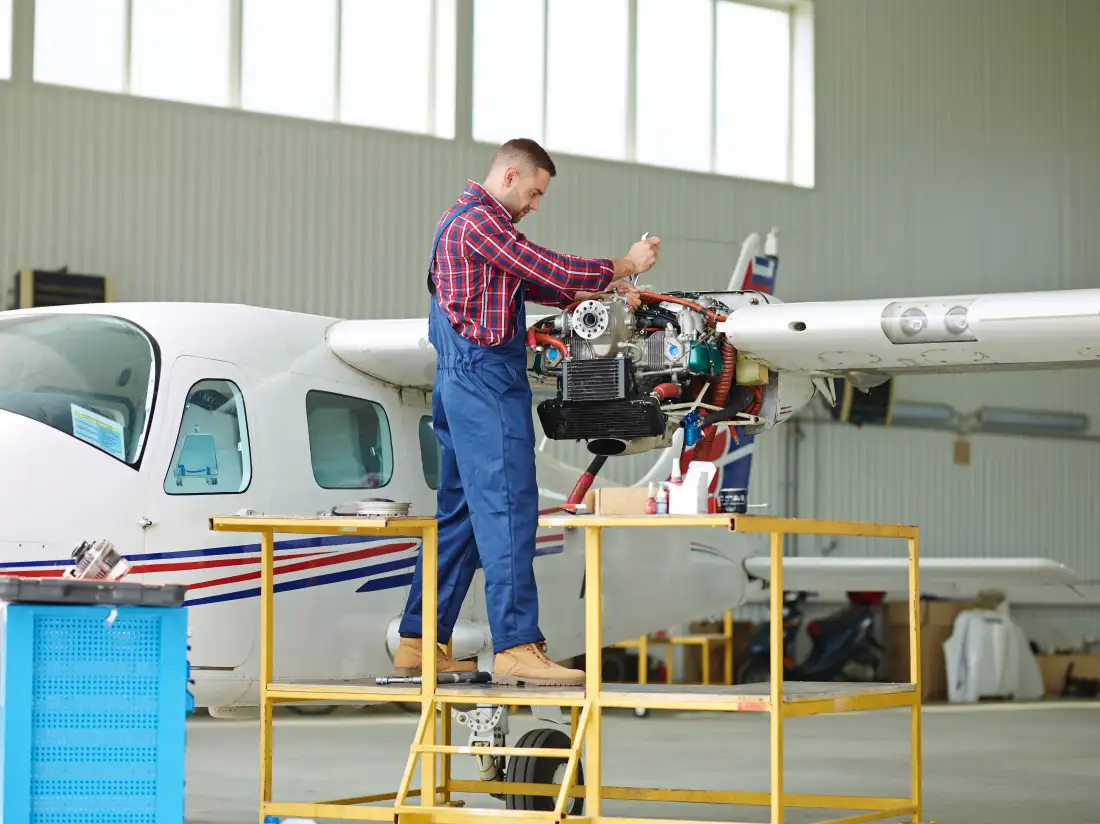
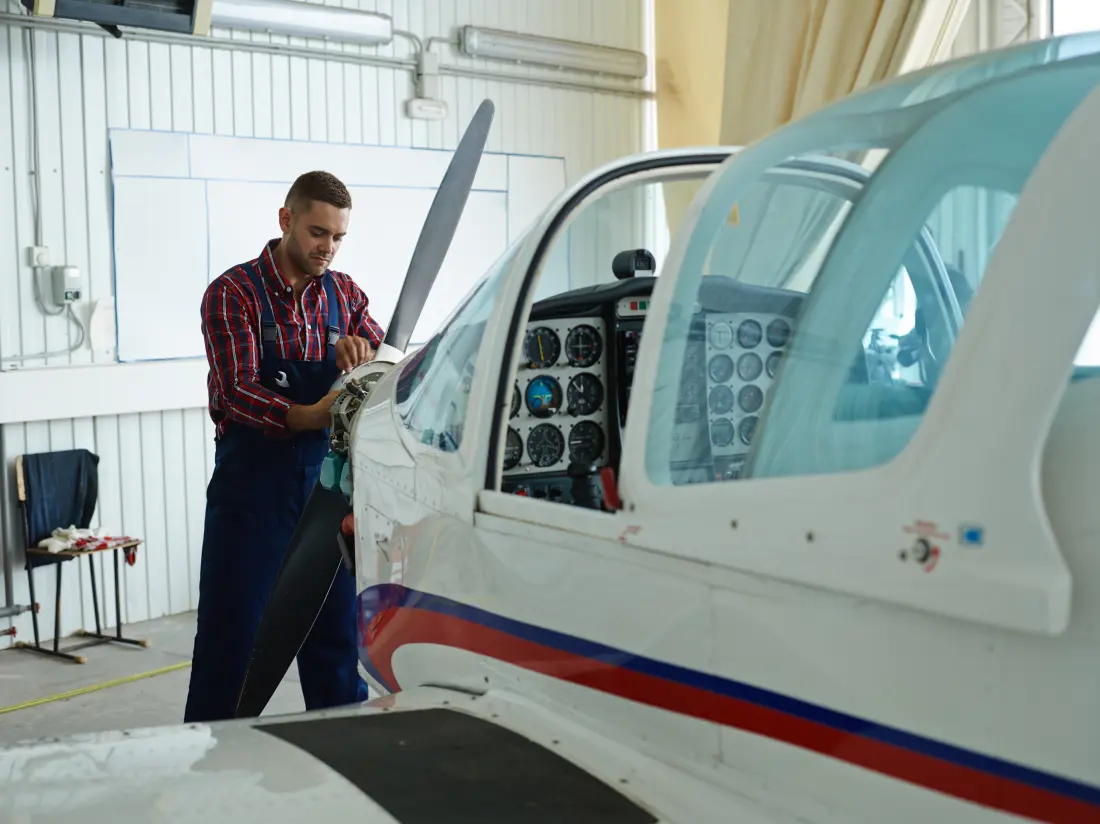
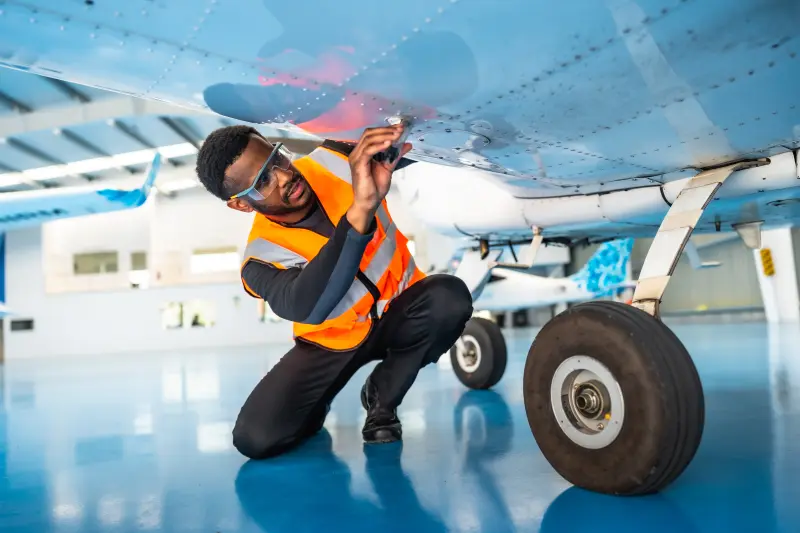
A B1-licensed engineer inspects, repairs, and certifies the mechanical and structural systems that keep an aircraft physically airworthy, everything from the airframe to the engines to the hydraulics. Day to day, that means troubleshooting mechanical faults, replacing structural components, testing engine performance, and signing off on maintenance within the qualification scope once authorized by the employer.
- Airframe structures: fuselage, wings, control surfaces, and structural repairs under approved data.
- Engines: turbine or piston engine inspection, removal, installation, and engine run-up, depending on subcategory.
- Mechanical systems: hydraulics, fuel systems, pneumatics, and landing gear.
- Flight control systems: cables, linkages, and actuators on the mechanical side.
- Simple avionics checks: basic serviceability tests on avionic line units that need no troubleshooting.
B1 splits into four subcategories depending on airframe and engine type, which is one of the clearest structural differences from B2: B1.1 (turbine aeroplanes), B1.2 (piston aeroplanes), B1.3 (turbine helicopters), and B1.4 (piston helicopters). B2 carries no equivalent split, since avionic and electrical systems don't vary by engine type the way mechanical systems do.

What Does a B2 Licensed Engineer Actually Do?
A B2-licensed engineer maintains, troubleshoots, and certifies an aircraft's avionics and electrical systems, essentially the electronic nervous system that handles navigation, communication, and flight monitoring. This is a single, unified category with no aircraft-type subcategories, since the underlying electronic and electrical disciplines apply across airframes.
- Communication and navigation systems: radios, SELCAL, ACARS, GPS, ADS-B, and related instrument systems.
- Flight management and autopilot: automatic flight control systems and their supporting electronics.
- Aircraft electrical power: generation, distribution, and APU electrical systems.
- Flight instruments and displays: electronic flight instrument systems, weather radar, and warning systems.
- Line-replaceable units (LRUs): removal, installation, and defect rectification in the avionics bay.
- Wiring and bonding: aircraft wiring, shielding, and electrical system certification.
Because B2's scope is defined by system type rather than airframe type, a B2 engineer's troubleshooting depth in electronics tends to run deeper than the "simple test" avionics work a B1 holder is authorized to sign off on, this is the clearest practical line between the two categories.

Shared Foundation: The Modules B1 and B2 Have in Common
B1 and B2 candidates study the same ten foundational modules before their training paths diverge into category-specific content. Per Commission Implementing Regulation (EU) 2023/989, which sets out the current Part-66 Appendix I basic-knowledge syllabus that PCAA-approved institutes generally align their own module structure against, both categories require the same core science and regulatory grounding before splitting into mechanical or avionics specialization.
| Module | Subject |
|---|---|
| M1 | Mathematics |
| M2 | Physics |
| M3 | Electrical Fundamentals |
| M4 | Electronic Fundamentals |
| M5 | Digital Techniques / Electronic Instrument Systems |
| M6 | Materials and Hardware |
| M7 | Maintenance Practices |
| M8 | Basic Aerodynamics |
| M9 | Human Factors |
| M10 | Aviation Legislation |
Because these ten modules are identical for both licenses, a student who hasn't yet committed to one category can study the shared foundation first and make the final B1-or-B2 call once they've had hands-on exposure to both mechanical and electrical coursework, rather than deciding blind in week one.
Where the Categories Diverge: B1-Only and B2-Only Modules
After the shared foundation, B1.1 candidates add three mechanical-specialist modules while B2 candidates add two avionics-specialist modules, which is why a B1.1 pathway runs to 13 total modules against B2's 12.
| Category | Additional Modules | Focus |
|---|---|---|
| B1.1 (Turbine Aeroplane) | M11 Turbine Aeroplane Aerodynamics, Structures & Systems; M15 Gas Turbine Engine; M17 Propeller | Airframe structures, engine mechanics, propulsion hardware |
| B2 (Avionics) | M13 Aircraft Aerodynamics, Structures & Systems (avionics-oriented); M14 Propulsion (systems-level) | Electronic systems integration across airframe and propulsion |
How Long Does B1 or B2 Training Take?
A full-time Part-66 program in Pakistan typically runs two to four years, depending on whether it's a compressed license-only route or a longer degree-attached pathway, and this timeline applies broadly whether a student is training toward B1, B2, or both. At Aviation Training Hub, the standard Aircraft Maintenance Engineering program runs two years across six semesters of four months each, with rolling intakes in January, April, July, September, and November.
| Fee Type | Amount | Details |
|---|---|---|
| Admission Fee | PKR 150,000 | Non-refundable, one-time |
| Semester Fee | PKR 140,000 | Per semester, 6 semesters of 4 months each |
| EASA Exam Fee | €139 per exam | 16 exams total (~€2,224 overall), payable one month before each module exam |
| On-the-Job Training (OJT) | Starting from PKR 8,000 | Depends on partner organization and scope |
Total core tuition works out to roughly PKR 990,000 across the full two years, with EASA module exam fees and OJT costs billed separately as students progress. Institutes teaching a combined B1/B2-aligned curriculum, as ATH does, generally run closer to the two-year end of the range since core foundation modules aren't duplicated across categories.

Can You Convert Between B1 and B2 Later?
Yes, an engineer holding one category can add the other through a documented conversion process rather than starting training from zero, since the ten shared foundation modules already satisfy part of the requirement. The competent authority reviews the module gap between the current license and the target category, then requires only the missing category-specific modules plus the matching practical experience.
- Step 1: Review the module gap between your current license and the target category.
- Step 2: Confirm which of the ten shared modules are already satisfied and which category-specific modules remain.
- Step 3: Collect documented practical experience records that support the new category's scope.
- Step 4: Sit the missing module exams through an approved training organization or competent-authority route.
- Step 5: Submit the application to the licensing authority with all supporting documentation.
- Step 6: Wait for license amendment and, where applicable, updated type-rating endorsements.
A B1 holder moving to B2 needs the avionics-specific modules (13 and 14) plus documented electrical/avionics practical experience; a B2 holder moving to B1 needs the mechanical-specific modules (11, 15, and 17 for the B1.1 pathway) plus mechanical practical experience. Because the shared foundation is never re-sat, adding a second category is a smaller lift than the first license, typically a matter of months of focused study rather than years.
Which License Pays More? Salary and Career Prospects
Neither B1 nor B2 consistently out-earns the other on its own; pay depends far more on fleet type, employer, region, and experience level than on category alone, though holding both categories reliably commands a premium over holding just one. In Karachi, the latest SalaryExpert compensation data puts entry-level Aircraft Maintenance Engineer pay at roughly PKR 1.2 million a year, rising to around PKR 1.85 million at the senior level, regardless of category.
| Experience Level | Estimated Annual Salary (PKR, Karachi) |
|---|---|
| Entry level (1-3 years) | Rs 1,200,800 |
| Median (all experience levels) | Rs 1,619,825 |
| Senior level (8+ years) | Rs 1,851,692 |
Internationally, employer job postings analyzed in mature EASA markets such as the UK show a consistent pattern: dual B1/B2 license holders are frequently offered a distinct pay supplement, commonly in the region of an additional several thousand pounds a year, on top of the base single-category salary, specifically because a dual-licensed engineer can certify both mechanical and avionics work without a second specialist on shift. That pattern is the clearest financial argument for pursuing both categories over a career, even if you start with only one.
Career Pathways: Where B1 and B2 Engineers End Up
Both categories offer a well-defined progression from junior line engineer to senior technical or supervisory roles, though the day-to-day specialization stays distinct until an engineer chooses to add the second category.
- B1 career ladder: Junior Mechanical Engineer → Line Maintenance Engineer → Base Maintenance Engineer → Lead Engineer → Quality or Maintenance Manager.
- B2 career ladder: Junior Avionics Technician → Avionics Engineer → Systems Specialist → Head of Avionics → Quality or Maintenance Manager.
- Shared endpoint: both ladders converge toward supervisory and quality-management roles once an engineer has several years of certifying experience, since those positions oversee both mechanical and avionics workstreams.
Graduates who want a management-track ending point without repeating foundational coursework can progress into a BSc (Hons) Aircraft Engineering Management top-up after completing their Part-66 license, which builds on the technical license rather than replacing it.
Should You Get Both? The Case for Dual B1/B2 Licensing
Holding both B1 and B2 makes sense for engineers who want maximum flexibility across employers and fleets, since a dual-licensed engineer can certify a wider range of work without waiting on a second specialist to sign off. This is genuinely one of the few career upgrades where the second license costs a fraction of the first, because the ten shared foundation modules are never repeated.
- Broader sign-off authority: a single engineer can certify both mechanical and avionics work on straightforward jobs.
- Fewer specialists needed on shift: smaller operators and MROs particularly value dual-licensed engineers for exactly this reason.
- Insurance against market shifts: if avionics work grows faster than mechanical work at a given employer, or vice versa, a dual license means neither shift affects your employability.
- Lower incremental cost: since the shared modules are already passed, the second license typically requires months rather than years of additional study.
The trade-off is that dual licensing is still an additional time and exam-fee commitment on top of the first category, so it's worth planning as a second phase after the first license and initial OJT are complete, rather than trying to sit both pathways from day one.
How to Decide: A Quick Decision Framework
If you're still undecided, match your natural preferences against the questions below rather than trying to guess which category pays better or hires faster, since both are in genuine demand.
| Question | Points to B1 | Points to B2 |
|---|---|---|
| What kind of problems do you enjoy solving? | Physical, mechanical faults you can see and touch | Electronic faults traced through wiring diagrams and test equipment |
| What did you enjoy most in school? | Mechanics, materials, structural physics | Electronics, digital systems, circuit theory |
| What work environment appeals to you? | Hangar floor, engine bay, structural repair | Avionics bay, cockpit, instrument panel |
| Do you want type-rating specialization on large aircraft? | Yes, B1 is the traditional route into airframe/engine type ratings | Possible, but avionics type-rating paths are narrower |
| Do you want the broadest possible employability from one license? | Strong, especially with a B1.1 rating on common jets | Strong, especially as aircraft become more software-driven |
If your answers split evenly across both columns, that's usually a sign to pursue one category first based on whichever appeals more day to day, then add the second through the conversion route once you're working and can judge the market firsthand.
Why Global Demand for Both Categories Is Rising in 2026
Demand for licensed aircraft maintenance engineers, in both categories, is climbing because of a genuine worldwide shortage rather than a regional blip. Boeing's 2026 Pilot and Technician Outlook projects 728,000 new maintenance technicians will be needed globally over the next 20 years to support fleet growth, part of more than 2.4 million new aviation personnel the report forecasts across pilots, technicians, and cabin crew combined.
- PIA's privatization is accelerating fleet growth. In January 2026, a private consortium led by Arif Habib Corporation took 75% management control of Pakistan International Airlines, with no government "golden share" retained. Per the U.S. International Trade Administration's Pakistan Aviation market intelligence brief, PIA's fleet is projected to more than double, from 18 operational aircraft to 38 by 2029, with its route network expanding from roughly 30 cities to more than 40.
- New aircraft need both categories certified before every flight. Every airframe entering a fleet needs both a B1-certified mechanical sign-off and a B2-certified avionics sign-off before its first revenue flight, so fleet growth translates directly into demand for licensed engineers in both categories, not just one.
- Modern aircraft are shifting more work toward avionics. As aircraft systems become more software- and sensor-driven, B2-scope work is growing as a share of total maintenance hours industry-wide, even as B1-scope structural and engine work remains the larger category by headcount.
Every new aircraft entering Pakistani or international fleets needs certifying signatures behind it in both categories, and there are not yet enough licensed engineers, in either B1 or B2, to fully meet that need, which is exactly the kind of supply-demand gap that favors new graduates entering the field now.

ATH's Perspective: How Aviation Training Hub Structures Training for Both Categories
The following section reflects Aviation Training Hub's (ATH) own program structure, not a third-party finding. Rather than forcing students to commit to B1 or B2 before they've had any hands-on exposure, ATH structures its two-year Aircraft Maintenance Engineering program so that the shared foundation modules, Mathematics, Physics, Electrical Fundamentals, Electronic Fundamentals, Digital Techniques, Materials & Hardware, Basic Aerodynamics, and Human Factors, come first in Year One, alongside Propellers (M17).
Year Two moves into the specialized modules mapped against Part-66 B1/B2 category requirements: Maintenance Practices, Aviation Legislation, Aeroplane Aerodynamics, Aircraft Aerodynamics/Structures/Avionic Systems, Gas Turbines, and Propulsion. Across the full program, students sit 16 module exams in total (approximately €139 per EASA module, payable one month before each exam), giving graduates a broad base that maps toward both mechanical and avionics competency rather than an artificially narrow track chosen in week one.
Assessment at ATH is deliberately assignment- and project-based rather than exam-only, students work through practical tasks that mirror real maintenance scenarios, which is intended to build applied judgment on both the mechanical and avionics side before a student has to commit fully to one category's specialist modules. The program runs from two campuses, Islamabad and Karachi, with genuine OJT access through partner organizations, since practical hours on real aircraft, not simulated-only training, are what regulators and employers actually look for.

Common Mistakes to Avoid When Choosing Between B1 and B2
- Choosing based on rumored salary differences alone. Pay depends far more on employer, fleet, and region than on category; a strong B1 engineer at a busy MRO can out-earn a mediocre B2 engineer at a quiet one, and vice versa.
- Assuming one category is "easier." B1's mechanical modules and B2's avionics modules both carry genuine technical depth; neither is a shortcut.
- Skipping the institute approval check. Confirm PCAA and, where relevant, EASA Part-147 approval status directly rather than from marketing material, regardless of which category you're pursuing.
- Underestimating OJT. Practical hours on real aircraft are not optional extras in either category, they are what regulators and employers actually look for before granting privileges.
- Ignoring the conversion pathway when deciding. Because the ten shared modules are never repeated, the "wrong" first choice is rarely a wasted one, you can add the second category later with a much smaller module load.
Conclusion
Deciding between a B1 and B2 aircraft maintenance license comes down to one honest question: do you want to spend your career on the mechanical side of the aircraft or the electronic side of it? Both categories share the same ten-module foundation, both lead to PCAA and EASA-recognized licensing, and both sit inside an industry that Boeing's 2026 outlook, Pakistan's own fleet expansion, and steady MRO hiring all point to as short-staffed for years to come. The category you choose first shapes your early specialization, not your ceiling, since the conversion route keeps the door to the other category open for as long as you want to walk through it.
If you're weighing this decision, look closely at your own aptitude for mechanical versus electronic problem-solving, confirm any institute's regulatory approval before enrolling, and remember that adding the second category later is a smaller step than most students assume.
Frequently Asked Questions
Common questions about choosing between a B1 and B2 aircraft maintenance license
B1 certifies mechanical work: airframes, engines, hydraulics, and structural systems. B2 certifies avionics work: electrical systems, instruments, navigation, and communication equipment. Neither license grants the other's certification authority.
Neither category consistently out-earns the other on its own, pay depends more on employer, fleet type, and region than on license category. Dual B1/B2 holders, however, commonly earn a distinct premium over single-category engineers in mature EASA job markets.
Both share 10 foundation modules (M1-M10). B1.1 adds 3 more (M11, M15, M17) for 13 total. B2 adds 2 more (M13, M14) for 12 total, per EASA Part-66 Appendix I.
Yes. Since the 10 shared modules are never re-sat, you only need the missing category-specific modules plus documented practical experience in the new scope, typically a matter of months, not a full second license from scratch.
For many engineers, yes. Dual-licensed engineers can certify a broader range of work without a second specialist on shift, which is why many operators pay a distinct premium for dual qualification, and the incremental cost is lower than the first license since shared modules aren't repeated.
Both have equal international recognition where an institute teaches the parallel EASA Part-66 syllabus alongside PCAA requirements. Recognition depends on the licensing framework and institute approval, not on which category you hold.
Match your natural interest: if you're drawn to physical, mechanical troubleshooting, B1 fits. If you prefer wiring, instruments, and electronic fault-finding, B2 fits. Both share the same first-year foundation, so you can decide with real coursework exposure rather than guessing.
Typically two to four years, depending on program type. A 2-year, 6-semester license program compresses coursework with concurrent OJT; a 4-year BSc AMET degree spreads the same Part-66 content further with an extended practical component and a full degree attached.
Yes. Boeing's 2026 outlook forecasts 728,000 new maintenance technicians needed globally over 20 years, while PIA's fleet is projected to grow from 18 to 38 aircraft by 2029 following its January 2026 privatization. Both trends point to sustained demand for licensed engineers in both categories.