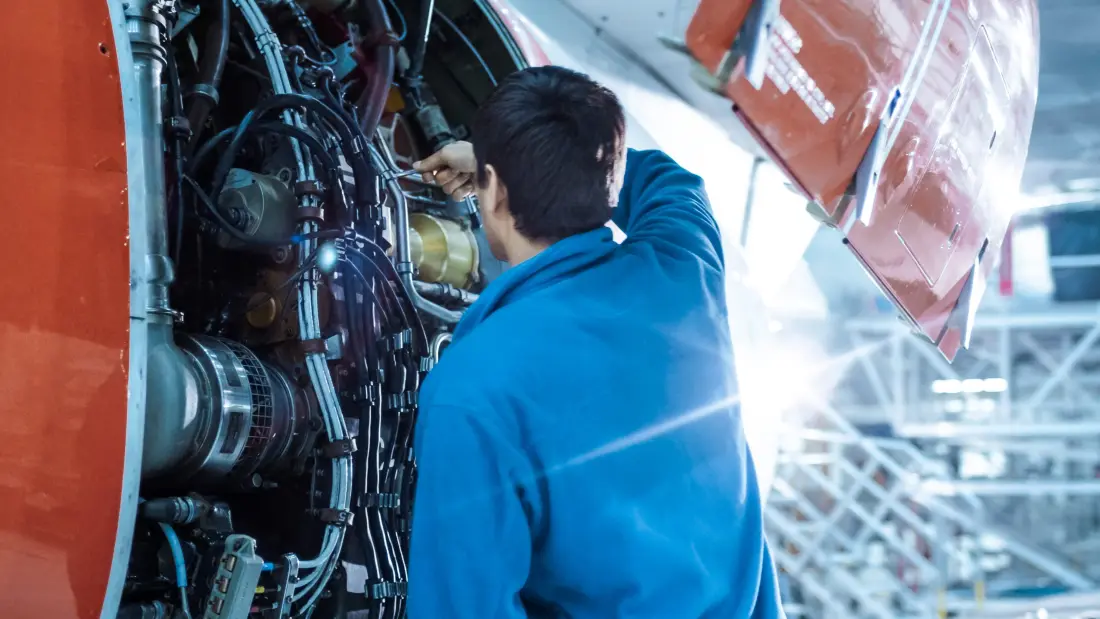
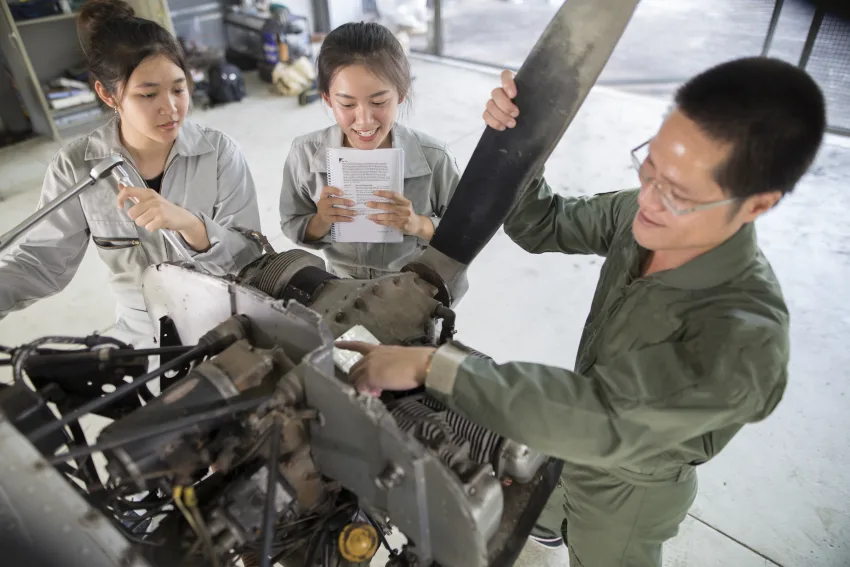
Line maintenance keeps an aircraft turning around between flights in under an hour, while base maintenance takes the same aircraft out of service for weeks and strips it down to its structure. The core difference is location and depth: line maintenance happens at the gate or in a line hangar and covers routine checks, defect rectification, and component swaps, while base maintenance happens in a dedicated heavy-maintenance hangar and covers structural inspections, major overhauls, and full system teardown. A day working line maintenance and a day working base maintenance look almost nothing alike, even though both roles report to the same Aircraft Maintenance Engineer (AME) license structure.
This guide walks through what actually separates the two disciplines under EASA and PCAA rules, then follows a real shift through each environment hour by hour, so anyone weighing Aircraft Maintenance Engineering training in Pakistan can see exactly what each career path involves day to day.
What Is Line Maintenance?
Line maintenance is limited maintenance carried out while an aircraft stays in its normal operating environment, meaning at the gate, on the ramp, or during a short turnaround between flights, rather than inside a dedicated maintenance facility. Under EASA's Part-145 continuing airworthiness rules, line maintenance specifically covers troubleshooting, defect rectification, component replacement, and scheduled checks that do not require extensive disassembly.
A line AME's job is speed without cutting corners. Find the fault, fix it or defer it correctly under the Minimum Equipment List, and sign the Certificate of Release to Service (CRS) before the next departure slot closes. Almost nothing about the work is casual, but nearly everything about it is compressed into a narrow window.
What Is Base Maintenance?
Base maintenance is any maintenance activity that falls outside the definition of line maintenance, per EASA's own Part-145 language, which in practice means anything requiring extended time, specialized tooling, or partial disassembly of the aircraft. It happens in a hangar built for the purpose, not on an active ramp.
Base checks run from a few days to several weeks. Panels come off, systems get tested individually rather than as a working whole, and every structural member gets inspected against the manufacturer's maintenance schedule and the regulator's airworthiness directives before the aircraft is closed back up and returned to service.

Line Maintenance vs Base Maintenance: Key Differences at a Glance
The fastest way to see the split is side by side. Line maintenance is measured in minutes and hours; base maintenance is measured in days and weeks, and that single difference in timescale explains almost every other contrast between the two disciplines.
| Factor | Line Maintenance | Base Maintenance |
|---|---|---|
| Location | Gate, ramp, or line hangar at the operating airport | Dedicated heavy-maintenance hangar |
| Typical duration | Minutes to a few hours per task | Days to several weeks per check |
| Aircraft state | Largely intact, minimal disassembly | Partially or fully disassembled |
| Planning horizon | Reactive, driven by the flight schedule | Scheduled months in advance |
| Typical tasks | Walk-around inspections, defect rectification, component swaps | Structural inspections, major overhauls, corrosion and NDT checks |
| Common checks | Transit checks, daily checks, A-checks | C-checks, D-checks (heavy maintenance visits) |
| Certifying category most involved | Category A or B1/B2 | Category B1/B2 progressing to Category C |
A Day in the Life of a Line Maintenance AME
A line AME's shift is built around the flight schedule, not a fixed to-do list, so no two days look identical even though the underlying rhythm repeats. Here is what a typical shift at a mid-sized Pakistani or Gulf airport looks like for a Category B1/B2 line engineer.
- Shift briefing: The outgoing shift hands over open defects, deferred items under the Minimum Equipment List, and any aircraft due for a transit or daily check before its next departure.
- Pre-flight and transit checks: Walk-around inspections confirm tyres, brakes, fluid levels, and visible structure are within limits before the aircraft is released for its next sector, often with only 30 to 45 minutes on the ground.
- Defect troubleshooting: A pilot report comes in mid-morning flagging an avionics fault on approach, and the engineer pulls the maintenance manual, isolates the fault to a single line-replaceable unit, and swaps it before boarding starts.
- Component replacement and minor repairs: Scheduled task cards call for replacing a worn brake unit or a cracked window seal, work that fits inside a single turnaround without pulling the aircraft off the schedule.
- Sign-off: Every task closes with a logbook entry and, where required, a Certificate of Release to Service, the legal statement confirming the aircraft is fit to fly again.
- Unscheduled disruption: A gate change, a weather delay, or a last-minute defect on a different aircraft can reorder the entire shift with no warning, which is why adaptability matters as much as technical skill in this role.
The through-line across all of it: everything is designed to be reversible or resolvable inside a single turnaround, and anything that cannot be fixed that fast gets deferred under MEL provisions or handed off to base maintenance instead.
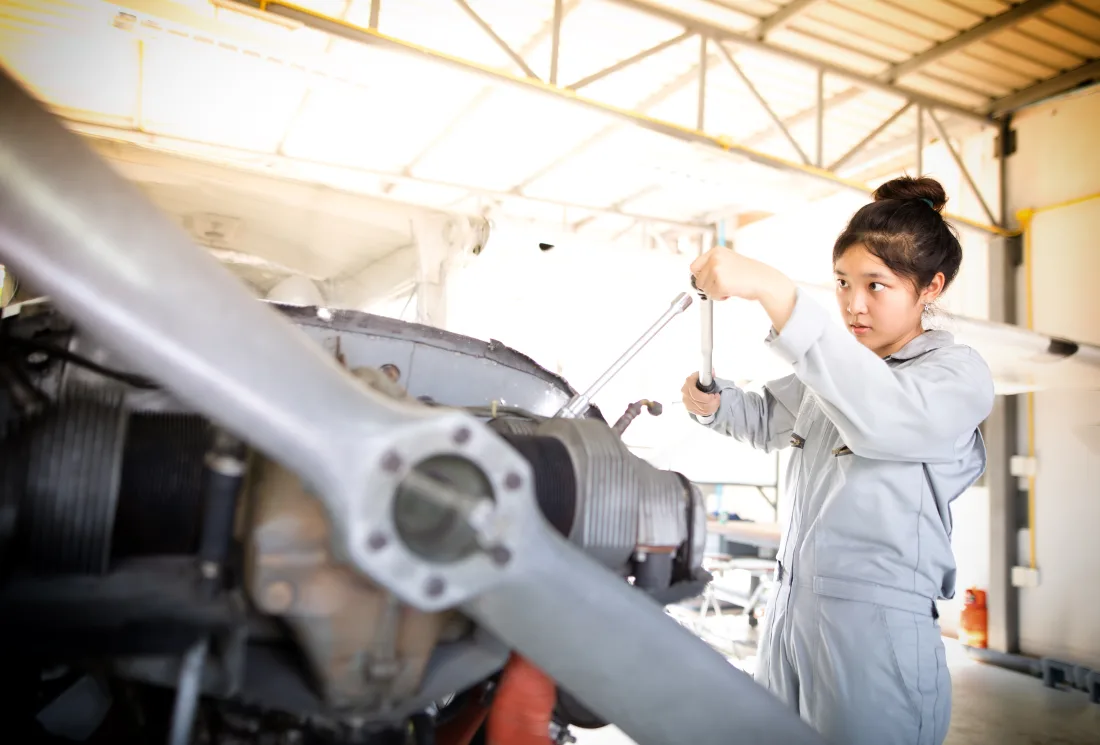
A Day in the Life of a Base Maintenance AME
A base maintenance AME's day is one stage inside a project that can run for weeks, so a single shift is judged by progress against a work-pack, not by how many aircraft moved through the hangar. Here is what a typical day inside a C-check looks like.
- Work-pack briefing: The shift starts with a review of the task cards scheduled for that day, drawn from a pack that can run to hundreds of individual line items for a single check.
- Panel removal and access: Access panels come off across the fuselage, wings, and belly fairings to expose structure, wiring looms, and system components a line check would never touch.
- Structural and NDT inspection: Non-destructive testing methods, such as eddy current, ultrasonic, or dye penetrant inspection, check for corrosion, cracking, and fatigue in structural members against the manufacturer's maintenance schedule.
- Non-routine write-ups: Every defect found beyond the planned scope gets logged as a non-routine task card, assessed, costed, and either actioned immediately or scheduled before the aircraft can close up.
- Component overhaul and reinstallation: Parts pulled earlier in the check come back from the shop overhauled or replaced, and reinstallation is checked against torque values and wiring diagrams before panels go back on.
- Progress sign-off: Each completed task card is signed and cross-checked, but the aircraft itself will not fly again until the entire pack, sometimes thousands of man-hours, is closed out.
Nothing here happens under the time pressure of a line turnaround, but the standard of thoroughness runs far higher, because a base check is often the only point in years where a given structural area gets opened up and inspected directly.

Check Types Explained: A, B, C, and D Checks
Airlines schedule four broad tiers of check, A through D, and each one sits further along the line-to-base spectrum. Understanding where each check falls explains why some AMEs spend a career mostly on the ramp while others spend it mostly in a hangar.
| Check | Typical Interval | Typical Duration | Environment |
|---|---|---|---|
| A-check | Every 400 to 600 flight hours (roughly 200 to 300 cycles) | Up to 60 man-hours, often overnight | Line / gate maintenance |
| B-check | Roughly every 6 to 8 months | Around 120 to 150 man-hours over 2 to 3 days | Line hangar |
| C-check | Roughly every 20 to 24 months, airframe-dependent | Up to 6,000 man-hours over about 3 weeks | Base maintenance hangar |
| D-check | Every 6 to 10 years, or around 20,000 flight hours | Up to 50,000 man-hours over roughly 2 months | Base maintenance hangar (heavy visit) |
Source for check-interval figures: AeroTime's breakdown of A, B, C, and D checks. Exact intervals vary by airframe type and each operator's approved maintenance programme, but the progression from hours-long line work to months-long base work holds across nearly every commercial aircraft type in service.
Which License Category Matches Which Environment?
Category A and B1/B2 licenses cover most line maintenance work, while Category C certifying staff sit almost entirely inside base maintenance. The categories are defined once under Part-66 and used identically by PCAA and EASA-aligned regulators, which is what lets a Pakistani-trained AME work toward international recognition later in a career.
| Category | Where It Works | Privileges |
|---|---|---|
| Category A | Line maintenance only | Limited certification for minor scheduled tasks and simple defect rectification |
| Category B1 | Line and base | Certifies airframes, engines, and mechanical/electrical systems; may cover simple avionics line-replaceable units |
| Category B2 | Line and base | Certifies avionics, electrical, and instrument systems |
| Category C | Base maintenance only | Issues the CRS after a full base check; requires at least three years' experience as certifying staff first |
Per ICAO's personnel licensing framework under Annex 1, aircraft maintenance is one of the specific professional categories requiring a formal international licensing standard, the regulatory backbone that both PCAA and EASA build their own category structures around.

Skills That Set Line AMEs and Base AMEs Apart
Line and base AMEs share the same foundational Part-66 training but sharpen very different working habits once they specialize. The day-to-day job selects for different strengths even though both start from the same syllabus.
| Skill | Matters More In Line | Matters More In Base |
|---|---|---|
| Speed under time pressure | Critical, every turnaround has a clock | Less relevant, work-packs run for weeks |
| Depth of structural knowledge | Useful, rarely tested in full | Critical, direct structural access is routine |
| Independent decision-making | High, often the only engineer on-site | Balanced with team coordination on a shared work-pack |
| Documentation precision | Fast-turnaround logbook entries and CRS | Extensive non-routine write-ups and NDT records |
| Variety vs. sustained focus | High variety, different aircraft daily | Deep focus on one aircraft over weeks |
Career Path: Should You Start in Line or Base Maintenance?
Most newly licensed AMEs in Pakistan rotate through both environments during on-the-job training before settling into a lane, and that exposure matters more than picking a side early. Line experience builds fast diagnostic instincts; base experience builds the structural depth that eventually leads toward a Category C certifying role.
Pay tends to track certifying responsibility rather than which environment an engineer works in day to day. Entry-level AMEs in Karachi start around Rs 1.1 to 1.3 million a year, rising toward Rs 1.7 million or more once an engineer holds senior certifying privileges, according to Aviation Training Hub's 2026 AME salary breakdown for Pakistan. A Category C certifying engineer working base checks and a senior B1/B2 engineer running a busy line station can end up earning similar figures; license category and years of certifying experience decide pay, not which hangar an engineer clocks into.
The demand backdrop favors either path. Boeing's 2026 Pilot and Technician Outlook projects 728,000 new maintenance technicians will be needed globally through 2045, and every one of those roles sits somewhere on the line-to-base spectrum described in this guide.

How Aviation Training Hub Exposes Students to Both Environments
The following section reflects Aviation Training Hub's (ATH) own programme structure, not a third-party finding. ATH's Aircraft Maintenance Engineering programme builds toward Part-66 B1/B2 categories across two years and six semesters, with on-the-job training placed at partner MROs, airlines, and maintenance organizations rather than run purely through classroom simulation.
Because OJT placements sit with real partner organizations, students typically see both sides of the split described above: ramp-style turnaround tasks at one placement, and hangar-based check work at another, depending on what each partner organization has scheduled during that rotation. ATH's assignment- and project-based assessment style is built to mirror this, students work through practical tasks that resemble real maintenance scenarios rather than exam-only theory, so moving into either a line station or a base hangar after licensing is not a student's first real exposure to either environment.
Common Misconceptions About Line vs Base Maintenance
- "Base maintenance is more advanced than line maintenance." They are different disciplines, not a hierarchy. A line engineer diagnosing an intermittent avionics fault in 30 minutes is not doing easier work than a base technician following a structured work-pack, just faster and more independent work.
- "Line AMEs don't need structural knowledge." Category A and B1/B2 line engineers still train on the full Part-66 structural syllabus; they simply apply less of it day to day than a base-focused Category C engineer does.
- "You pick line or base and stay there forever." Movement between the two is common, especially early in a career, and many senior certifying engineers have worked substantial time in both.
- "Base maintenance means slower career progression." Category C certifying privileges, which require base experience, sit among the highest-paid tiers in the license structure.
Conclusion
Line maintenance and base maintenance solve the same underlying problem, keeping an aircraft airworthy, from opposite ends of the timescale. A line AME's day is built around a flight schedule that will not wait; a base AME's day is one stage inside a work-pack that can run for weeks. Neither environment is a lesser version of the other, and most Pakistani AMEs work meaningful stretches in both before a Category C certifying role, if they pursue one, pulls them fully into base maintenance.
If you are weighing a career as an AME, look for a training programme that gives you real OJT exposure to both environments before you have to choose a lane.
Frequently Asked Questions
Common questions about line maintenance vs base maintenance and the AME roles behind each
Line maintenance happens at the gate or ramp in minutes to hours and covers routine checks and defect rectification. Base maintenance happens in a dedicated hangar over days to weeks and covers structural inspections, overhauls, and full teardown.
A transit or daily line check typically takes 30 to 45 minutes, while a full A-check runs to about 60 man-hours, usually completed overnight so the aircraft flies its schedule the next day.
A C-check can run to roughly 6,000 man-hours over about three weeks. A D-check, the heaviest maintenance visit, can total 50,000 man-hours over roughly two months.
Yes. Category B1 and B2 licenses cover both environments, and most newly licensed engineers rotate through line and base work during on-the-job training before specializing.
Category B1 or B2 covers most base maintenance tasks. Category C, which issues the final Certificate of Release to Service after a full base check, requires at least three years of prior certifying experience.
Neither is objectively better. Most Pakistani AMEs get OJT exposure to both before choosing, since line work builds fast diagnostic skill while base work builds the structural depth needed for senior certifying roles.
Yes, both train on the same Part-66 syllabus and hold the same base license categories (A, B1, or B2). The difference is which skills get used daily, not which exams were passed to get there.
A shift briefing, back-to-back transit and pre-flight checks, troubleshooting a defect reported by a pilot, a component swap, and signing a Certificate of Release to Service before each aircraft departs, often across several different aircraft in one shift.