Choosing between an Aircraft Maintenance Engineer (AME), Cabin Crew, and Airport Management career in Pakistan comes down to three trade-offs: AME demands two to four years of technical training but leads to the highest licensed salary ceiling, Cabin Crew offers the fastest entry into aviation with strong travel perks but a flatter pay curve, and Airport Management sits in between, a shorter diploma-to-degree path with genuine leadership growth into six-figure-dollar-equivalent roles. All three sit inside an industry that Boeing projects will need 1,710,000 new technicians and cabin crew members worldwide through 2044, with South Asia among the fastest-growing regions on earth for aviation hiring.
This guide compares all three paths side by side: what each job actually involves, what training costs and how long it takes, what the career ladder and salary look like at entry, mid, and senior level, and which one fits which kind of person. Where the AME path is concerned, this guide also draws on Aviation Training Hub's (ATH) own AME program as a real, worked example of how the licensing route plays out in practice.

What Are AME, Cabin Crew, and Airport Management Careers?
AME, Cabin Crew, and Airport Management are three distinct entry points into Pakistan's aviation industry, one technical and licensed, one passenger-facing and mobile, and one operational and ground-based. Each has its own qualifications, training path, and career ceiling, so understanding what the job actually involves day to day matters more than the job title alone.
What Is an Aircraft Maintenance Engineer (AME)?
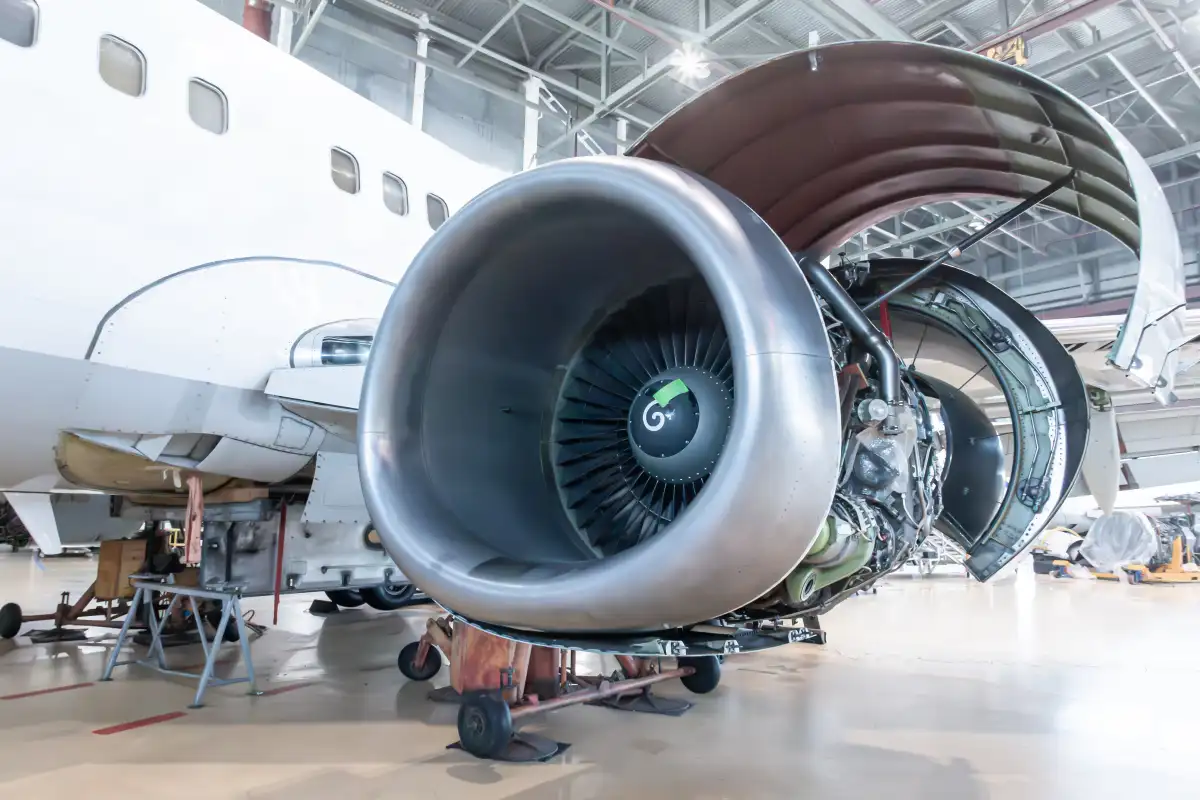
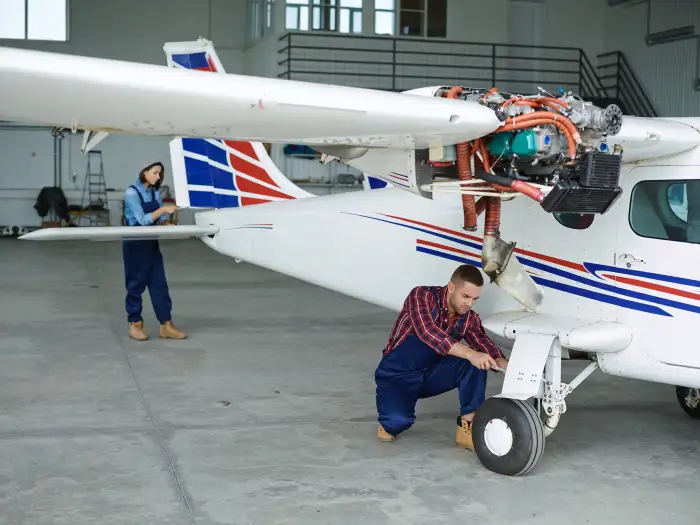
An Aircraft Maintenance Engineer is a licensed professional who inspects, repairs, and certifies aircraft as airworthy before every flight, no aircraft legally departs without an AME's sign-off. The role combines mechanical and electronics expertise with direct legal responsibility, since the engineer's signature on a Certificate of Release to Service confirms the aircraft is safe to fly.
What Is Cabin Crew?
Cabin Crew are airline staff responsible for passenger safety, emergency response, and in-flight service aboard an aircraft. Their job blends safety-critical training (evacuation procedures, first aid, fire suppression) with customer-facing hospitality, and they report to a flight's cabin supervisor or purser during operations.
What Is Airport Management?
Airport Management covers the ground-based planning, coordination, and supervision of airport or airline operations, including passenger flow, cargo handling, ground services, customer service, and administrative functions that keep an airport running on schedule. Unlike AME or Cabin Crew, this path never requires working on board an aircraft or holding an engineering license.
| Aspect | AME | Cabin Crew | Airport Management |
|---|---|---|---|
| Work environment | Hangar, workshop, aircraft | Aboard the aircraft, in flight | Airport terminal, ground operations |
| Core focus | Technical inspection and certification | Passenger safety and service | Operations, coordination, leadership |
| License required | Yes (PCAA/EASA) | Airline-issued certification | No license, employer training |
| Travel involved | Minimal, based at hangar/MRO | Extensive, route-dependent | Minimal, based at one airport/hub |

Eligibility and Entry Requirements Compared
Entry requirements differ sharply across the three paths: AME needs a specific science background, Cabin Crew has age and physical criteria set by individual airlines, and Airport Management is the most flexible on academic entry but increasingly favors a bachelor's degree at officer level.
| Requirement | AME | Cabin Crew | Airport Management |
|---|---|---|---|
| Minimum education | Matric or FSc (Pre-Engineering/Pre-Medical) with 50% in Math and Physics | Intermediate (FA/FSc) minimum, graduates preferred by full-service carriers | Intermediate for support roles, bachelor's degree favored for officer-level posts |
| Age range | No strict cap, most students enter at 17-20 | Typically 18-27 at first hire, varies by airline | 18-35 typical range for government aviation bodies |
| Physical/other criteria | Colour vision and general medical fitness for licensing | Height, grooming, swimming ability, and English/Urdu fluency, set per airline | No standard physical criteria, communication and computer proficiency weighted heavily |
| Licensing body | PCAA and/or EASA Part-66 | Individual airline certification, renewed periodically | No personal license, employer and CAA operational training |
Per ICAO's Personnel Licensing framework, AME is the only one of the three paths where the qualification itself is a government-issued, internationally recognized license rather than an employer-specific certification. That distinction is what gives AME a portable credential Cabin Crew and Airport Management roles generally do not carry between employers.
Training Duration and Structure Compared
AME training takes the longest at two to four years, Cabin Crew training is the shortest at a few weeks to a few months, and Airport Management sits in between at roughly four months for a diploma up to several years for a full aviation management degree.
| Path | Typical Duration | Structure |
|---|---|---|
| AME | 2-4 years | Foundational modules (Year 1), specialized modules (Year 2), progressive EASA/PCAA module exams, mandatory on-the-job training (OJT) |
| Cabin Crew | A few weeks to 4-6 months | Safety and emergency procedures, first aid, service standards, grooming, and a probationary period after airline selection |
| Airport Management | 4 months (diploma) to 2-4 years (degree) | Airport operations, ground services, customer service, cargo handling, aviation administration and security modules |
The nine-step AME sequence is the most regulated of the three: meeting entry requirements, choosing a PCAA/EASA-approved institute, clearing admission, completing foundational then specialized modules, sitting 16 progressive EASA module exams, finishing genuine OJT hours on live aircraft, and only then applying for the license. Cabin Crew and Airport Management training, by contrast, is set by the individual airline or academy rather than a shared international framework, which is also why their course lengths vary so much more from provider to provider.
What Does Each Path Cost in Pakistan?
AME training carries by far the highest upfront cost of the three because it includes a two-year institutional program, per-module EASA exam fees, and mandatory OJT placement, while Cabin Crew and Airport Management courses are shorter, employer- or academy-run, and cost a fraction of a full AME program.
| Cost Component | AME (2-Year Program) | Cabin Crew | Airport Management |
|---|---|---|---|
| Core tuition | ~PKR 990,000 (admission + 6 semester fees) | Varies widely by academy and format, generally a fraction of AME tuition | Often a few months of diploma fees, considerably lower than a full engineering program |
| Exam/certification fees | ~€139 per EASA module, 16 exams total (~€2,224) | Included in most airline-run training programs | Included in most diploma/degree fees |
| Practical/OJT costs | Starting from PKR 8,000, depending on partner | Usually airline-funded once hired | Usually institute-funded internship placement |
| Overall investment level | Highest, longest payback horizon | Lowest, fastest entry | Moderate, faster than AME but longer training than most Cabin Crew courses |
Cabin Crew and Airport Management course fees vary enormously across Pakistani training providers depending on whether the course is online, academy-based, or degree-level, so there is no single reliable national figure the way there is for a regulated EASA program. What stays consistent is the trade-off: AME's higher upfront cost buys a government-issued, internationally portable license, while Cabin Crew and Airport Management training buys faster, cheaper entry into the industry with an employer-dependent credential.

Career Growth and Progression Compared
Airport Management offers the widest long-term ceiling of the three because ground operations experience compounds into airline and airport leadership roles, AME offers the most structurally guaranteed progression because each license category unlocks a defined next step, and Cabin Crew offers meaningful but comparatively flatter growth once a person reaches senior crew or trainer level.
- AME progression: Category B1 or B2 license, then Category C certifying staff after at least three years of experience, with a further option to top up into a management-track bachelor's degree for engineering leadership roles.
- Cabin Crew progression: Flight Attendant, Senior Cabin Crew, Cabin Crew Trainer, or Cabin Supervisor, with growth largely capped inside airline operations rather than extending into other departments.
- Airport Management progression: Operations or customer service executive, then station or department supervisor, then airport manager or senior operations leadership, with scope to move across airlines, ground handlers, airports, and regulators.
Both AME and Airport Management give graduates a credential that survives an employer change: an AME's license is portable across airlines and MROs, and airport operations experience is transferable across ground handling companies, airlines, and the airport authority itself. Cabin Crew experience is valuable but tends to stay most useful within airline-side roles specifically.
Salary Comparison: AME vs Cabin Crew vs Airport Management in Pakistan (2026)
Airport Management carries the highest senior-level salary ceiling of the three career paths in Pakistan, AME offers the most consistent mid-career salary growth backed by a license, and Cabin Crew sits closest to AME at entry level but grows more slowly toward the senior end.
| Career Path | Entry-Level Role & Salary (PKR/year) | Mid-Career Salary (PKR/year) | Senior/Leadership Salary (PKR/year) |
|---|---|---|---|
| AME | Junior licensed engineer, Karachi: Rs 1,192,382 | Licensed AME, Karachi: Rs 1,681,780 | Senior/Category C engineer, Karachi: Rs 2,034,954 |
| Cabin Crew | Flight Attendant: Rs 1,397,082 | Flight Attendant (average): Rs 1,984,492 | Senior Cabin Crew/Trainer: Rs 2,407,189 |
| Airport Management | Station/Operations Executive: Rs 1,331,135 | Station Manager: Rs 1,937,605 | Airport Manager: Rs 4,937,923 |
These figures come from ERI's Pakistan compensation database (Flight Attendant, Airline Station Manager, and Airport Manager job categories, national averages) and the closest matching Karachi-specific AME category the same database tracks. Actual pay varies by city, employer type, and whether an AME holds a full B1/B2 license or is still completing modules, but the pattern across all three paths is consistent: Airport Management's senior tier pulls ahead once someone reaches an Airport Manager-level post, largely because that role carries broader operational and P&L responsibility than a single aircraft or cabin.
Job Market Demand and Growth Outlook for 2026 and Beyond
All three aviation career paths in Pakistan are riding the same growth wave: a privatizing national carrier expanding its fleet, a domestic passenger market that has nearly doubled in under two decades, and a South Asian region Boeing flags as one of the fastest-growing for aviation staffing worldwide.
| Demand Driver | Global Figure (through 2044) | South Asia Figure |
|---|---|---|
| New maintenance technicians needed (AME) | 710,000 | 45,000 |
| New cabin crew needed | 1,000,000 | 51,000 |
Per Boeing's 2025 Pilot and Technician Outlook, South Asia and Southeast Asia are the fastest-growing regions for aviation personnel, with staffing demand expected to more than triple over the forecast period. Boeing's outlook does not separately model ground and airport operations staffing, but the underlying driver, more aircraft flying more routes, feeds Airport Management demand just as directly.
- PIA's privatization is accelerating fleet growth. In January 2026, a private consortium led by Arif Habib Corporation took 75% management control of Pakistan International Airlines in a $645 million deal. Under the new ownership's plan, PIA's fleet is projected to more than double, from 18 operational aircraft to 38 by 2029, with routes expanding from roughly 30 to more than 40 cities.
- Pakistan's passenger traffic has nearly doubled since 2007. Pakistani airports handled approximately 24.3 million passengers in 2024-25, up from 12.8 million in 2006-07, according to Superior University's ORIC analysis of Pakistan's aviation economy. Every additional passenger and aircraft movement adds direct load to ground operations, customer service, and airport management staffing, not just to cockpit and cabin crews.
- New aircraft mean new certifying signatures. More than 25 new aircraft are expected to enter Pakistani fleets in 2026 alone, the highest single-year influx in the country's aviation history, each one requiring licensed AMEs to keep it airworthy.
Every one of these trends points the same direction: more aircraft, more passengers, and more routes all require more AMEs to certify airworthiness, more Cabin Crew to staff flights, and more Airport Management professionals to run the ground operation behind them.

Skills You Need to Succeed in Each Path
Each path rewards a different core skill set: AME rewards technical precision and independent judgment, Cabin Crew rewards composure and people skills under pressure, and Airport Management rewards coordination and decision-making across many moving parts at once.
| AME | Cabin Crew | Airport Management |
|---|---|---|
| Technical reading of manuals, wiring diagrams, and airworthiness directives | Emergency response and first aid under pressure | Multi-stakeholder coordination across airlines, ground staff, and security |
| Mechanical and systems understanding across airframes, engines, and avionics | Clear, calm communication with diverse passengers | Scheduling and resource planning under time pressure |
| Decision-making under pressure with real safety consequences | Physical stamina for long-haul and irregular hours | Customer service recovery during delays and disruptions |
| Attention to detail on small, easily missed defects | Adaptability across cultures, languages, and routes | Data-driven reporting and compliance documentation |
Which Path Should You Choose?
The right choice depends less on which career pays more on paper and more on what kind of daily work you actually want: hands-on technical problem-solving, people-facing travel, or ground-level operational leadership.
Choose AME If...
- You enjoy hands-on mechanical, electrical, or technical problem-solving.
- You want a government-issued license that travels with you between employers and countries.
- You are comfortable with two to four years of structured training before entering the workforce.
- You want the highest long-term earning trajectory backed by a regulated qualification rather than employer discretion.
- You would rather work on aircraft than fly on them.
Choose Cabin Crew If...
- You want the fastest possible entry into a paying aviation career.
- You enjoy travel, meeting new people, and international exposure.
- You have strong communication and composure skills under pressure.
- You are comfortable with irregular hours and time away from home.
- You want strong entry-level pay without years of upfront training investment.
Choose Airport Management If...
- You want a ground-based aviation career without flying on a rotating schedule.
- You are drawn to operations, logistics, and leadership rather than a single technical specialty.
- You want a shorter training path than AME but a longer-term leadership ceiling than most Cabin Crew tracks.
- You are comfortable working your way up from operations or customer service roles into management.
- You want flexibility to move across airlines, ground handlers, and airport authorities over your career.
How Aviation Training Hub Structures Its AME Program
The following section reflects Aviation Training Hub's (ATH) own program, not a third-party finding. ATH's core specialization is the Aircraft Maintenance Engineering pathway specifically, not Cabin Crew or Airport Management training, so this section speaks only to how ATH structures the AME route among the three careers compared above.
ATH runs its AME program across two years and six semesters of four months each, with rolling intakes in January, April, July, September, and November rather than a single annual cycle. Entry requires a Matric or FSc qualification (Pre-Engineering or Pre-Medical accepted) with a minimum of 50% in Mathematics and Physics, the same threshold used across the eligibility comparison above.
Assessment at ATH is deliberately assignment- and project-based rather than exam-only, students work through practical tasks that mirror real maintenance scenarios, intended to build applied judgment alongside theoretical knowledge. The program runs from two campuses, Islamabad and Karachi, and its fee structure breaks down as follows.
| Fee Type | Amount | Details |
|---|---|---|
| Admission Fee | PKR 150,000 | Non-refundable, one-time |
| Semester Fee | PKR 140,000 | Per semester, 6 semesters of 4 months each |
| EASA Exam Fee | €139 per exam | 16 exams total (~€2,224 overall), payable one month before each module exam |
| On-the-Job Training (OJT) | From PKR 8,000 | Depends on partner organization and scope |
Graduates who want the management-track ceiling that Airport Management offers, without abandoning the AME license they trained for, can progress into a BSc (Hons) Aircraft Engineering Management top-up rather than starting a separate degree from scratch. It is one route into leadership and management-track roles that keeps the licensed AME credential intact rather than trading it away.
If Cabin Crew or Airport Management genuinely fits your goals better than the technical AME route after weighing the comparison above, the right move is to look specifically at institutes and airlines that specialize in that training, since ATH's own program is built around the AME licensing pathway.

Common Mistakes to Avoid When Choosing Between These Aviation Careers
- Choosing based on salary alone. Airport Management's senior-tier ceiling looks attractive on paper, but it takes years of ground-level experience to reach, the same way an AME license takes years of modules and OJT before the higher pay kicks in.
- Underestimating how different the daily work is. AME is technical and stationary, Cabin Crew is mobile and people-facing, Airport Management is operational and coordination-heavy, picking the wrong fit leads to early burnout regardless of the pay.
- Skipping the license/approval check for AME specifically. Enrolling in an AME program before confirming PCAA or EASA Part-147 approval can mean a license that is not recognized where you eventually want to work.
- Assuming Cabin Crew has no growth ceiling. Growth exists (Senior Crew, Trainer, Supervisor) but stays largely inside airline cabin operations rather than expanding into other departments the way Airport Management or an AME's engineering-management top-up can.
- Ignoring documentation and English proficiency. All three paths involve technical manuals, safety procedures, or compliance paperwork; weak documentation skills slow down licensing, certification, and hiring alike.
Conclusion
AME, Cabin Crew, and Airport Management each open a genuine, in-demand aviation career in Pakistan in 2026, and none of them is objectively "better" than the others, they simply reward different strengths and different timelines. AME rewards patience and technical aptitude with the most portable, highest-ceiling license of the three. Cabin Crew rewards people skills and adaptability with the fastest entry and strong early travel exposure. Airport Management rewards operational thinking with the broadest long-term leadership ceiling.
If you are still weighing the three, start by being honest about whether you want to work on aircraft, fly on them, or run the operation around them, then use the training length, cost, and salary comparisons above to match that instinct against the practical trade-offs of each path.
Frequently Asked Questions
Common questions about choosing between AME, Cabin Crew, and Airport Management
None is universally better, each rewards a different strength. AME offers the most portable license and the strongest structured salary growth. Cabin Crew offers the fastest entry and strong early travel exposure. Airport Management offers the broadest long-term leadership ceiling. The right choice depends on whether you want technical work, travel, or operational leadership.
At the senior level, Airport Manager roles pay the highest of the three, around Rs 4.9 million a year, versus roughly Rs 2.4 million for senior Cabin Crew and Rs 2 million for a senior AME in Karachi. At entry level, the three paths sit much closer together, all in the Rs 1.2-1.4 million range annually.
Cabin Crew has the fastest entry, often a few weeks to a few months of airline-run training. Airport Management diplomas typically run around 4 months, with degree routes taking longer. AME takes the longest at 2 to 4 years, since it involves a government-issued license rather than an employer certification.
Movement is possible but easier in some directions than others. An AME license is a standalone technical credential that does not automatically transfer into Cabin Crew or Airport Management work. Airport Management experience can transfer relatively easily across ground handling, airline, and airport-authority roles. Cabin Crew experience is valuable in customer-facing aviation roles but does not substitute for AME's regulated qualification.
AME involves more structured academic and practical assessment, including 16 progressive EASA module exams and mandatory on-the-job training on live aircraft, which makes it more demanding in scope and duration. Cabin Crew and Airport Management training is shorter and more service/operations-focused rather than exam-heavy, but each still has its own selection and certification standards set by the airline or academy.
All three are growing together. Boeing projects 710,000 new maintenance technicians and 1,000,000 new cabin crew needed globally through 2044, with South Asia flagged as one of the fastest-growing regions. Pakistan's own passenger traffic nearly doubled from 12.8 million to 24.3 million between 2006-07 and 2024-25, and PIA's fleet is projected to grow from 18 to 38 aircraft by 2029, all of which drives demand across AME, Cabin Crew, and Airport Management roles at once.
AME requires Matric or FSc with 50% in Math and Physics. Cabin Crew typically requires Intermediate-level education plus age, height, and language criteria set by the hiring airline. Airport Management accepts Intermediate for support-level roles, with a bachelor's degree increasingly favored for officer-level positions.
Both AME and Airport Management are ground-based careers that do not require flying on a rotating schedule. AME is the more technical of the two, spent mostly in a hangar or workshop, while Airport Management is the more operational and leadership-focused of the two, spent mostly in a terminal or operations office.
None of the three paths are formally restricted by gender in Pakistan, all accept qualified candidates regardless of gender. Age flexibility varies: AME has no strict cap since it depends on academic entry requirements, Cabin Crew hiring typically targets an 18-27 age range at first hire, and government aviation bodies relevant to Airport Management commonly use an 18-35 range.
AME has the strongest built-in international portability, since an EASA Part-66 license is recognized across the European Union and by many international operators alongside domestic PCAA recognition. Cabin Crew and Airport Management roles can also lead abroad, particularly in the Gulf, but typically depend on the hiring airline or employer rather than a single internationally standardized license.